
EVAPLUS 54.6V Safe Charger
4.4Editor score
UL certified 48V charger
Automatic full-charge shutoff
Red and green status LEDs
Wide-range AC input
Our 10 best Ebike Replacement Charger picks compare voltage, connector fit, charging speed, safety features, portability, and compatibility for 48V and 36V
An e-bike replacement charger must do more than fit the charging port. It must match the battery chemistry, supply the correct voltage and current, and include dependable protections against overheating, short circuits, and overcharging. The best option also offers a connector configuration that suits your particular bike or scooter.
We compared all ten chargers using the specifications and compatibility information supplied for each product. The comparison covers battery voltage, output current, connector coverage, charging indicators, safety functions, portability, and the types of e-bikes or scooters each charger is designed to support.
The list includes eight chargers for 48V lithium-ion systems and one dedicated 36V charger, with a final 48V option that adds an especially broad equipment-compatibility list. Each review explains the strongest features and the trade-offs, while current prices and availability can change over time.
4.4Editor score
4.6Editor score

4.4Editor score
This side-by-side comparison highlights each charger's battery target, output, connector coverage, safety credentials, and intended applications, making it easier to identify a compatible replacement before purchasing.


This is a general-purpose 48V lithium-ion replacement charger rated 4.3, with a straightforward 54.6V two-amp output and five adapter plugs. Its appeal lies in balancing useful physical versatility with basic charging protections. It is designed to serve e-bikes and electric scooters from a selection of popular brands rather than concentrating on one narrow connector standard.
We may earn a commission when you buy through this link, at no additional cost to you.
The five included adapters are the main convenience feature, allowing a single charger body to serve different charging-port styles. The stated output is appropriate for a 48V lithium pack, while the listed protections cover overcharging, short circuits, overvoltage, and overcurrent. Solid red and solid green LEDs remove uncertainty by indicating active charging and a fully charged battery.
Compared with the larger seven-connector options in this guide, this model offers less breadth, and the information does not claim laboratory certification. Its UL-listed status and four-part protection scheme still make it a reassuring general replacement. Buyers should nevertheless compare the original charger label, battery voltage, chemistry, and port geometry before assuming compatibility.
This is a good choice for a rider who wants a reasonably versatile 48V charger with clear indicators and recognizable brand support. It is especially attractive for users of Rad Power Bikes, Velotric, Heybike, Juiced, or Ecotric machines whose ports match an included adapter. For anyone with an unusual connector or multiple battery classes, the seven-plug models offer more room for uncertainty.
Five adapter plugs reduce the need to keep separate chargers for several common e-bike brands. The listed compatibility with Rad Power Bikes, Velotric, Heybike, Juiced, and Ecotric makes the model relevant to a broad group of mainstream riders, though exact model and connector confirmation remains essential.
The red and green LED states provide a simple way to distinguish charging from completion. This removes the uncertainty of staring at a cable and wondering whether the charger is actively delivering power.
We may earn a commission when you buy through this link, at no additional cost to you.
This UL-certified charger carries a 4.2 rating and supplies 54.6V at two amps for 48V lithium-ion battery packs. It specifically names the Lectric XP 2.0 and 3.0, Ecotric City and Beach, and Evercross H5 and H7, making it a practical choice for riders who know the model of their electric bike.
We may earn a commission when you buy through this link, at no additional cost to you.
Its five connector options cover a DC barrel style, a 12mm aviation plug, and a cannon-style connection. The charger operates with a 100–240V, 50/60Hz input and uses a CC-CV approach that automatically stops when the battery reaches full charge. Its safety list includes protection against overvoltage, overcurrent, short circuits, excessive temperature, reverse connection, and fuse faults.
The limitation is that this charger is restricted to lithium-ion batteries and does not support lead-acid packs. Some buyers may also want the broader plug assortment offered by the seven-connector alternatives. Even so, the explicit certification and extensive protection list make it a reassuring choice for the named 48V models.
Choose this charger when your bike is a compatible Lectric, Ecotric, or Evercross and the included plug matches the port. It is a sensible choice for someone prioritizing a recognized safety certification and a conventional two-amp charging profile. Confirm the battery label and connector before ordering, because compatibility with a brand name does not guarantee compatibility with every variant.
The stated CC-CV working mode is intended to control the transition from charging to the fully charged state. Automatic shutoff adds another layer of protection, although the battery's own charging requirements remain the deciding factor.
Named support for Lectric XP 2.0 and 3.0, Ecotric City and Beach, and Evercross H5 and H7 gives buyers a useful starting point. Port design can vary, so matching the original charger and the included connector remains necessary.
We may earn a commission when you buy through this link, at no additional cost to you.
This five-plug universal charger has a 4.2 rating and is designed around a 48V lithium-ion battery with a 54.6V two-amp output. Unlike chargers limited to a single barrel format, it includes several three-prong and specialty connector options, making it relevant for e-bikes, electric bicycles, One Wheel devices, and Rad Power Bike users.
We may earn a commission when you buy through this link, at no additional cost to you.
The connector set consists of a 5.5 by 2.5mm one-prong DC plug, an 8mm mini three-prong connector, a 12mm standard three-prong connector, an 8mm RCA connector, and a three-pin male XLR connector. A 100–240V input supports use in many regions, while CC-CV operation, automatic completion behavior, and overcurrent, overvoltage, overload, and short-circuit protection support safer charging.
Its two-amp output provides a conventional fast-charging option without moving into unusually high-current designs. The tradeoff is that it still offers fewer connector types than the leading seven-plug models, and lead-acid battery packs are explicitly excluded. Some specialty connector combinations are also different from those found in the premium choices, so physical fit must be confirmed.
This is a well-rounded choice for a 48V rider who wants more than one or two connector formats and appreciates clearly described smart-charging behavior. It suits users of One Wheel devices, Rad Power bikes, and other compatible electric equipment. Before ordering, compare both the connector shape and any polarity markings with the existing charging port.
The mix of barrel, mini three-prong, standard three-prong, RCA, and XLR connections is more varied than a basic two-connector replacement. That makes the charger useful for owners of several kinds of 48V electric equipment.
A red-to-green indication light shows the progression from active charging to completion. The supplied information also states that the charger automatically maintains the battery once charging is finished.
We may earn a commission when you buy through this link, at no additional cost to you.
The EVAPLUS 54.6V Safe Charger is a focused replacement for 48V lithium batteries and carries a 4.4 rating. Its principal appeal is simplicity: it uses the common DC barrel format, offers a 100–240V input, and has a UL-certified design with automatic shutoff when the battery is fully charged.
We may earn a commission when you buy through this link, at no additional cost to you.
Compatibility is stated for electric bikes, scooters, and other devices using 48V lithium packs with 5.5 by 2.5mm or 2.1mm connectors. The stated charging time for most compatible 48V 13S batteries is approximately four to six hours. Red and green LEDs show charging and completion, while overvoltage, overcurrent, and short-circuit protection provide the core safeguards.
Compared with the multi-plug choices, this charger has a smaller connector range and is less likely to suit an unusual e-bike port. It also provides fewer compatibility details for named models. In exchange, it presents a cleaner proposition for riders who already know their equipment uses a standard barrel connection and want a certified, uncomplicated replacement.
This is the best budget-oriented pick for a straightforward 48V barrel-port replacement. It is particularly suitable for owners who prioritize UL certification, clear status lights, and worldwide input support over a large collection of adapters. Verify the port diameter and battery label before buying, and do not use it with an incompatible chemistry or voltage.
UL certification, automatic shutoff, and three named electrical protections create a strong safety foundation without a large adapter bundle. The result is easier to understand and carry, especially for riders replacing one failed charger.
A 100–240V AC input makes the charger suitable for many different mains systems. This is helpful for travelers, though the attached battery connector still needs to match the equipment.
We may earn a commission when you buy through this link, at no additional cost to you.
This EVAPLUS charger is the dedicated 36V option in the guide, with a 4.2 rating. It outputs 42V at two amps for 36V lithium batteries, making it relevant to smaller e-scooters rather than the 48V systems served by most other products here. The supplied information states that a typical 36V battery can charge in about four to six hours.
We may earn a commission when you buy through this link, at no additional cost to you.
Three connector formats are included: a 0.31-inch one-prong connector, a 0.31-inch mini three-prong connector, and a 5.5 by 2.5/2.1mm female DC connector. The product is described as fitting Razor Pocket Mod and Sports Mod models and most 36V e-scooters using those connector types. SGS certification is paired with short-circuit, overcurrent, overvoltage, and polarity-error protection.
The important restriction is that it will not serve a 48V bike, and the listed exclusions include the Hover-1 Ranger, Jetson with a three-pin XLR, and any 24V or lead-acid battery. Its compact 5.03 by 2.16 by 1.57-inch body is a genuine advantage, but choosing it for a 36V scooter requires greater attention to connector and model exclusions than choosing among the 48V options.
Choose this charger when your scooter has a 36V lithium pack and one of the three supported connectors. It is a well-certified and portable solution for the right equipment, supported by a one-year replacement warranty. Owners of 48V e-bikes should skip this model and focus on a 54.6V charger instead.
The compact dimensions make the charger easy to store in a backpack or scooter compartment. Portability is particularly relevant for 36V scooters whose owners may already be carrying other riding equipment.
SGS certification is backed by protections for short circuits, excess current, excess voltage, and polarity errors. A one-year replacement warranty adds a useful support commitment if the charger stops working within the stated period.
We may earn a commission when you buy through this link, at no additional cost to you.
The QKIIP is the premium pick in this guide, earning a 4.4 rating through a combination of seven connector tips, a 54.6V two-amp output, and a three-stage CC/CV charging profile. It is built specifically for 48V 13S lithium-ion batteries, which narrows its application but gives it a clear technical target.
We may earn a commission when you buy through this link, at no additional cost to you.
Its connector collection includes 5.5 by 2.1mm and 2.5mm barrel plugs, a 12mm three-prong plug, a 9mm mini three-prong plug, an 8mm RCA plug, a three-pin XLR connector, and a three-prong female universal option. The product supports numerous named brands and models, including Lectric XP 2.0 and 3.0, Ecotric City and Beach, RadRunner 2, Aventon, Ancheer, Jetson Haze, Velotric, Ninebot, and others.
Protection against overvoltage, overload, overcurrent, excessive temperature, and short circuits is combined with a fire-resistant casing. A three-stage smart-charging process is intended to protect battery health, while red and green indicators show charge status. The limitations are substantial: it must not be used with 36V, 42V, 24V, 52V, or lead-acid batteries, and only 48V 13S lithium packs qualify.
This is the top choice for a rider who values the widest adapter assortment in the guide and wants clear pre-purchase compatibility guidance. The supplied product information recommends checking the battery label, confirming that the original charger reads 54.6V, and matching the port. Those three checks are essential whenever buying a replacement charger.
Seven distinct tips give this model broader coverage than most competitors, ranging from common barrel connectors to three-prong, RCA, and XLR formats. That variety is especially useful for households owning more than one compatible 48V machine.
The three-stage CC/CV approach is intended to manage the battery through different points of the charging cycle. Together with automatic protection and a full set of electrical safeguards, it gives the charger a more technical feature profile than a basic replacement.
We may earn a commission when you buy through this link, at no additional cost to you.
This 54.6V two-amp charger has a 3.9 rating and focuses on 48V 13S lithium-ion battery packs. It combines a seven-plug assortment with a flame-retardant V-0 enclosure, multiple electrical protections, and a stated aging-test process. The lower rating than the other choices does not erase those useful attributes, but it makes close comparison important.
We may earn a commission when you buy through this link, at no additional cost to you.
The included connections cover a 5.5 by 2.1mm one-prong plug, a 5.5 by 2.5mm one-prong plug, a 9mm mini three-prong connector, a 12mm standard three-prong connector, an 8mm RCA connector, a three-pin male XLR connector, and a universal IEC plug. Input supports 100–240V at 50/60Hz, while output is 54.6V at two amps.
Overvoltage, overcurrent, short-circuit, and temperature protection are joined by automatic shutoff and a red-to-green status display. The product information states that every unit undergoes aging testing, which is a meaningful quality-control claim. However, compatibility is strict: the charger is only for 48V 13S lithium packs and excludes lead-acid batteries and every other voltage class.
Choose this option if seven connectors, a flame-retardant case, and SGS certification matter most, and if your battery is unquestionably a 48V 13S lithium system. Its 3.9 rating is lower than those of the other multi-connector picks, so buyers should weigh the included protections and connector range against the available alternatives.
The flame-retardant V-0 enclosure is a notable construction feature for a device that naturally produces heat while operating. Temperature protection adds another layer, although proper ventilation and an unobstructed charging surface remain good practice.
The stated aging tests are intended to support consistent real-world performance. Buyers can also use the red and green lights to confirm that the charger has entered either the charging or completed state.
We may earn a commission when you buy through this link, at no additional cost to you.
The Hyleton charger carries a 4.4 rating and is a feature-rich 48V lithium replacement delivering 54.6V at two amps. It is explicitly designed for e-bike batteries rather than electric scooters, hoverboards, motorcycles, or lead-acid systems, giving it a clearly defined audience among riders with compatible 48V e-bikes.
We may earn a commission when you buy through this link, at no additional cost to you.
Its three-in-one connector system includes a 5.5 by 2.5/2.1mm DC plug, a 12mm three-prong plug, and an 18mm XLR plug. The product information names a long list of e-bike brands and models, including Lectric XP versions, Ancheer, Jasion, Funhang, TST, Heybike, Himiway, ESKUTE, and others. A storage bag is also included for keeping the charger and cables together.
The charger is described as UL certified and as meeting TUV, SGS, CE, FCC, and RoHS standards. It features overvoltage, overcurrent, short-circuit, and overheating protection, a V-0 flame-retardant housing, and temperature control. Its fanless design allows silent operation, while the LED sequence distinguishes being plugged in, actively charging, and reaching full charge.
This is a strong pick for an e-bike owner who values silent operation, broad brand support, and a high level of documentation. The trade-offs are meaningful: it has only three connector formats, and it expressly excludes many other rideable types. It is also unsuitable for 52V, 60V, 72V, LiFePO4, and several other battery classes, so careful label verification is essential.
Unlike chargers that use a cooling fan, this model is described as operating completely silently. That can be convenient at home, in a garage, or anywhere a fan would add avoidable noise.
The included velvet storage bag gives the charger and cables a dedicated place in a garage, closet, or travel bag. It is a small convenience that helps prevent loose connectors and cable clutter.
We may earn a commission when you buy through this link, at no additional cost to you.
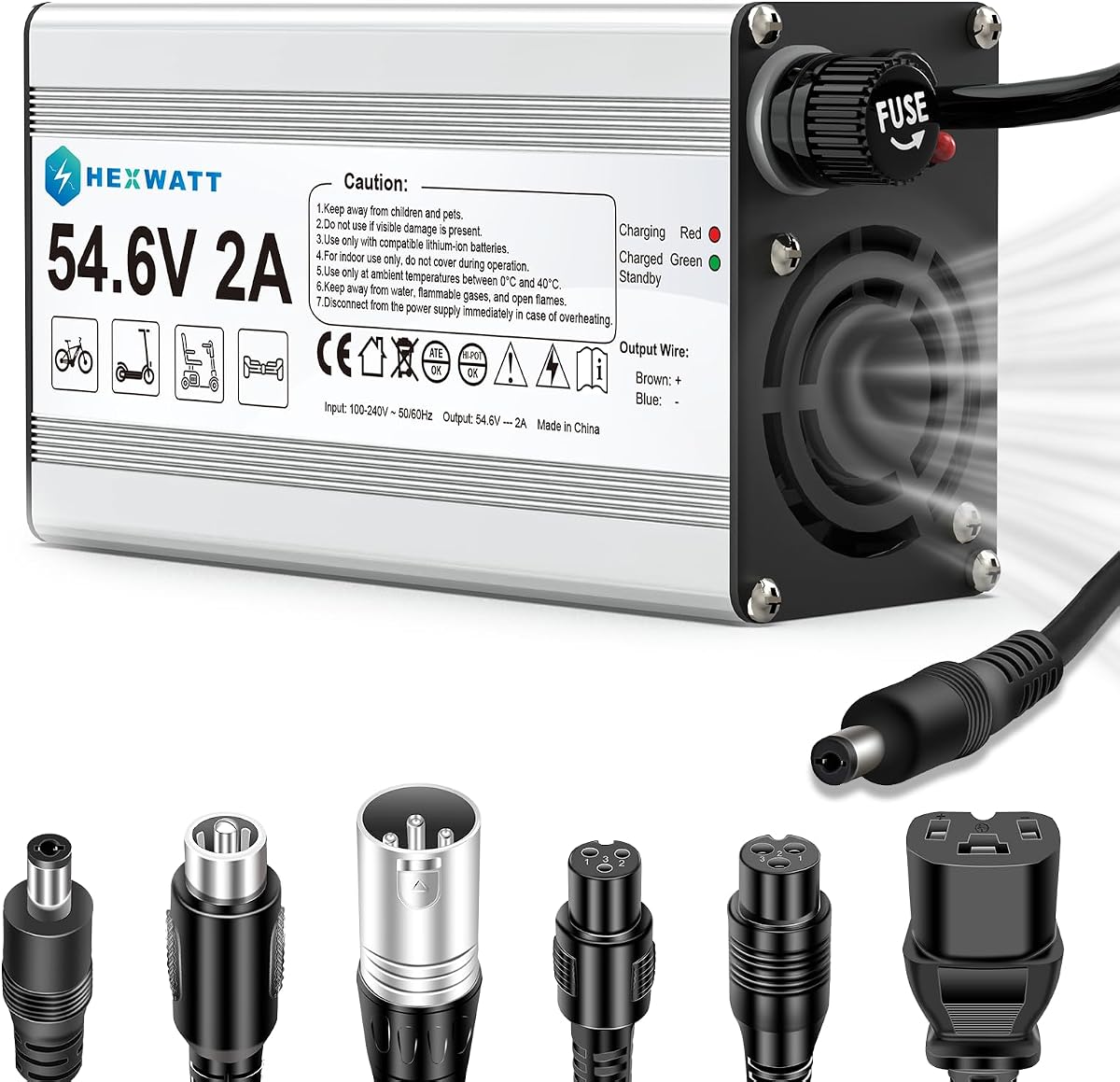
This charger earns the highest rating in the guide at 4.6, combining seven interchangeable connectors with an unusually extensive compatibility list. It is designed for 48V 13S lithium-ion NMC battery packs that require 54.6V charging, with a regulated two-amp output suitable for e-bikes and certain 48V electric scooters.
We may earn a commission when you buy through this link, at no additional cost to you.
The compatibility information covers many Lectric XP configurations, numerous Rad Power models, Ride1Up bicycles, GOTRAX bikes and scooters, Himiway, Heybike, SONDORS, ECOTRIC, Aventon, Hiboy, Apollo, EVERCROSS, Kaabo, VMAX, Kukirin, VSETT, and EMOVE products. Seven connector formats increase the chance of finding a physical match, while compatibility can still differ by model year.
The charger uses a durable aluminum housing, a quiet cooling fan, flyback technology, a replaceable fuse, PWM control, and CPU-based management. It is described as tested by a CNAS ISO/IEC 17025-accredited laboratory against CSA and UL 62368-1 standards. Overvoltage, overcurrent, overheating, and short-circuit protections are joined by automatic shutoff and a red or green status light.
This is the editor's choice because it combines the guide's highest rating, seven connectors, extensive named-model support, and detailed safety information. It is not appropriate for LiFePO4, lead-acid, 52V, 60V, or 72V batteries. Buyers should confirm chemistry, voltage, connector size, polarity, and pinout, especially when purchasing for an older model year.
The extensive list spans e-bikes, folding bikes, fat-tire bikes, commuters, and selected 48V scooters. This makes the charger particularly attractive to households that own multiple compatible machines and want one versatile power supply.
The stated laboratory testing and replaceable fuse add transparency and practical serviceability. A quiet cooling fan supports heat management, while intelligent PWM and CPU control regulate the 54.6V two-amp output.
We may earn a commission when you buy through this link, at no additional cost to you.
This six-plug charger has a 3.8 rating and offers a 54.6V two-amp output for 48V lithium-ion devices. It positions itself as a durable replacement for e-bikes, scooters, and hoverboards, with an aluminum alloy housing, broad 100–240V input, and a simple process of selecting the appropriate connector before charging.
We may earn a commission when you buy through this link, at no additional cost to you.
The product information names Gotrax, Hiboy, Jetson, Segway, Ninebot, and Razor among compatible brands. Its interchangeable connector selection is intended to reduce the need to keep several chargers, while automatic trickle mode is designed to take over after the battery reaches full charge. The charger also includes protections against overvoltage, overcurrent, short circuits, and excessive temperature.
Its housing is described as sturdy, scratch-resistant, and corrosion-resistant, with an emphasis on heat dissipation. The plug-and-play design is convenient, but the lowest rating in this roundup warrants careful attention to the actual connector, battery chemistry, and port polarity. It should not be assumed to fit every brand simply because a name appears in a compatibility list.
Choose this model for a 48V rider who values durable construction, automatic trickle charging, and international mains compatibility. It is a reasonable option for many mainstream scooters and e-bikes, but the seven-plug models provide more flexibility and the two top-rated products offer stronger model-specific guidance. Confirm that the equipment uses a supported 48V lithium system before ordering.
The aluminum alloy casing is intended to dissipate heat while resisting scratches and corrosion. Those qualities make it a practical choice for a charger that may live in a garage, backpack, or scooter compartment.
Automatic trickle charging is intended to maintain a full battery more gently than continuous high-current charging. The state should still be monitored through the charger's indicator rather than assumed.
We may earn a commission when you buy through this link, at no additional cost to you.
A replacement charger must satisfy three independent requirements: the electrical output must match the battery, the connector must physically and electrically match the port, and the safety system must be appropriate for the battery chemistry. The following factors help narrow the options without overlooking a critical detail.
Start with the label on the battery, not merely the voltage printed on the bike listing or charger listing. Most products in this guide are intended for 48V 13S lithium-ion packs and should charge at 54.6V. The EVAPLUS 42V model is different: it is designed for a 36V lithium battery and outputs 42V at two amps. Lead-acid, LiFePO4, 24V, 36V, 42V, 48V, 52V, 60V, and 72V systems are not interchangeable merely because their physical connectors look similar.
In short, match both nominal battery voltage and chemistry before considering any other feature. A connector that fits does not make an electrically compatible charger.
The 48V chargers in this guide output 54.6V, which corresponds to the full-charge voltage for the targeted 13S lithium-ion packs. Their common current rating is two amps, providing a familiar fast-charging profile. The 36V charger also supplies two amps but uses the appropriate 42V output. Current must still agree with the battery maker's charging requirements and the original charger's label, especially for higher-capacity packs.
Choose a voltage and current that exactly match the original charger. A superficially similar output should never be used as the sole basis for compatibility.
Connector selection involves more than diameter. Barrel plugs can differ in outer diameter and inner opening, while three-prong connectors can vary in pin arrangement and shape. RCA, XLR, aviation-style, and mini three-prong formats add further complexity. The included-tip count is useful, but a visual match should also be checked against the original charger label, port markings, and the charger's compatibility instructions.
Prioritize a charger that explicitly includes the connector used by your bike or scooter. If the fit is uncertain, send the seller a photograph of the port and original label before ordering.
UL certification appears on several picks, while SGS certification is highlighted on others. Certification is one part of safety, while built-in protection against overvoltage, overcurrent, short circuits, temperature extremes, reverse connection, and polarity errors provides another. CC-CV control and automatic shutoff help manage the charging cycle once the battery reaches its target voltage.
Look for recognized certification, multiple protection functions, and clear automatic termination behavior. A charger that lacks these safeguards is not a better candidate simply because it costs less.
Five plugs cover a useful range for many mainstream products, while six or seven connectors provide additional coverage for uncommon ports. The most detailed compatibility list belongs to the 4.6-rated seven-connector charger, which names many Rad Power, Lectric, GOTRAX, Aventon, ECOTRIC, and other models. The QKIIP model also provides seven tips and an extensive named-brand list, including a helpful three-check purchasing process.
A larger assortment is useful when the charger may serve several devices. For a single known bike, a correctly named and correctly sized connector is more valuable than a long compatibility list.
Smart charging behavior helps distinguish a useful replacement from a basic power supply. CC-CV operation manages the shift between constant-current and constant-voltage stages, while automatic shutoff or trickle charging can reduce the risk of continued unnecessary charging. Red and green LEDs are common across the guide and make it easier to tell whether the charger is actively charging or has completed its cycle.
Look for automatic completion, a mode suitable for the battery chemistry, and a status light that can be read at a glance. A charger that requires constant supervision is less convenient for regular use.
Chargers generate heat, so housing material and cooling design deserve attention. Several options use aluminum bodies, one relies on a quiet cooling fan, and the Hyleton uses fanless operation with stated temperature-control technology. The 36V EVAPLUS charger is particularly compact at 5.03 by 2.16 by 1.57 inches, which can be useful for scooter storage. A carrying pouch is also included with the Hyleton.
Select a charger that suits the location where it will be used. Leave ventilation around the housing, avoid obstructed surfaces, and consider whether noise, size, or cable organization matters for your routine.
Brand support is most useful when the manufacturer lists exact models rather than only a brand family. Several options name Lectric XP versions, Ecotric City and Beach, and Evercross H5 and H7. The broadest product description covers many e-bike and scooter models, but it also notes that fit can vary by model year. Named compatibility should therefore be treated as a helpful guide, not a substitute for checking the exact port and battery.
Look for a product whose supported list includes your exact model and connector. When no exact match is available, a photo-based compatibility check is the safest next step.
Before connecting anything, remove the charger and compare its output label with the label on the original charger and battery. Confirm the battery is the supported voltage and chemistry, then inspect the charging port for dirt, bent pins, or moisture. Select the matching connector, push it in fully without forcing it, and connect the charger to a suitable wall outlet before plugging it into the bike or scooter.
Watch the indicator light during the first charge. A steady red light generally means charging, while green generally signals completion, although the exact sequence can vary by model. Do not leave the connector exposed, do not use a visibly damaged cable, and do not attempt charging in standing water or in a wet environment. Keep the charger on a stable, hard, ventilated surface rather than on soft fabric.
Unplug the charging connector from the battery promptly after completion, especially if the charger does not switch into a verified trickle or maintenance mode. Coil the cable without creating a tight bend at the plug, keep the charger dry, and store it in the supplied bag or another protected location. Periodically clean the port with a dry cloth and inspect the connector for corrosion or physical wear. If the battery behaves unusually, stops accepting a charge, becomes unusually hot, or shows visible damage, stop using the charger and have the battery and charging system inspected.
The 48V lithium-ion batteries covered in this guide use a 54.6V charger, matching the full-charge voltage of a 13S pack. Most selected chargers deliver two amps. Always confirm that the battery is 48V 13S lithium-ion and that the original charger also reads 54.6V before choosing a replacement.
No. A 42V charger is intended for a 36V lithium battery and will not provide the correct charge voltage for a 48V 13S pack. The connector may physically fit in some situations, but electrical compatibility matters more than physical fit. Use a charger specified for the battery's actual voltage and chemistry.
Look at the shape and dimensions of the charging port, then compare it with the included connector tips and the charger listing. Pay attention to barrel diameter, inner diameter, and the number and arrangement of pins. If the match is uncertain, compare the original charger label and send the seller a clear photograph of the port.
No. A matching plug may still have a different pinout, polarity, voltage requirement, or communication arrangement. Compare the charger's output label with the battery or original charger, confirm the battery chemistry, and use a product whose compatibility information explicitly supports your equipment.
The chargers in this guide are for lithium-ion systems, and many explicitly exclude lead-acid and LiFePO4 chemistry. The EVAPLUS 42V model is limited to a 36V lithium battery, while most of the remaining products target 48V 13S lithium-ion packs. Use a charger specifically rated and approved for any other battery chemistry.
On the listed chargers, red generally indicates active charging and green generally indicates that charging is complete. Some models also show green when disconnected or not charging, so the product's own instructions remain the final reference. The light should be used together with the battery's own gauge or display, where available.
The EVAPLUS 48V and 36V models state approximate charging times of four to six hours for compatible packs. Charging time for other products can vary with battery capacity, state of charge, charger output, temperature, and battery condition. The listed two-amp output is a common fast-charging rating across the guide.
Most of the 48V chargers list a 100–240V AC input, which supports use with many international mains systems, while the EVAPLUS 36V model also lists 100V–240V input. The attached equipment connector still must match, and you may need a suitable country-specific mains plug or travel adapter.
The EVAPLUS 54.6V Safe Charger is a streamlined budget-friendly option for standard 48V barrel connections, the QKIIP is the premium choice for seven-tip flexibility and a three-stage charging profile, and the 4.6-rated seven-connector charger earns the editor's choice for its exceptional combination of model coverage, laboratory testing, and interchangeable connectors. Each serves a different but clearly defined compatibility need.
Before buying, prioritize battery voltage, chemistry, output voltage, and connector pinout over every other feature. Certification, CC-CV behavior, automatic shutoff, temperature protection, and visible indicators add confidence and convenience, but none can compensate for an electrical mismatch. If your exact bike is listed, verify its model year and charging-port style; if it is not listed, request a compatibility check before completing the order.
Ratings, connector availability, and current prices can change over time, so recheck the listing and customer feedback before purchasing. Take a photograph of the original charger label and battery label, compare them with the replacement's specifications, and retain the original charger until the new unit has completed a proper charging cycle.