
LiNKFOR 192kHz DAC Converter
4.8Editor score
192kHz PCM decoding
Integrated amplifier chip
Built-in RCA cable
Compact plug-and-play design
This expert guide compares 10 Optical to RCA Adapter options, covering PCM and surround decoding, outputs, high-resolution audio, build quality, and setup.
An optical to RCA adapter lets a modern television, game console, Blu-ray player, or streaming box send sound to an older amplifier or stereo system that only accepts analog RCA inputs. A good converter preserves the source signal, provides a clean analog output, and avoids complicated setup or compatibility surprises.
The products in this guide were compared using their stated sampling rates, supported audio formats, input and output connectors, cable design, power requirements, and volume-control options. The list covers compact PCM-only converters, detachable models with RCA and 3.5mm outputs, adjustable units, and surround-capable designs.
Each review explains the features that distinguish the adapter, including supported formats, cable length, amplifier integration, and practical compatibility. Rankings reflect the supplied product information, while current prices and availability can change, so readers should verify the latest listing before buying.
4.8Editor score

4.4Editor score
4.4Editor score
The table highlights the major differences among all ten adapters, including audio-format support, connection flexibility, integrated volume control, and physical design.

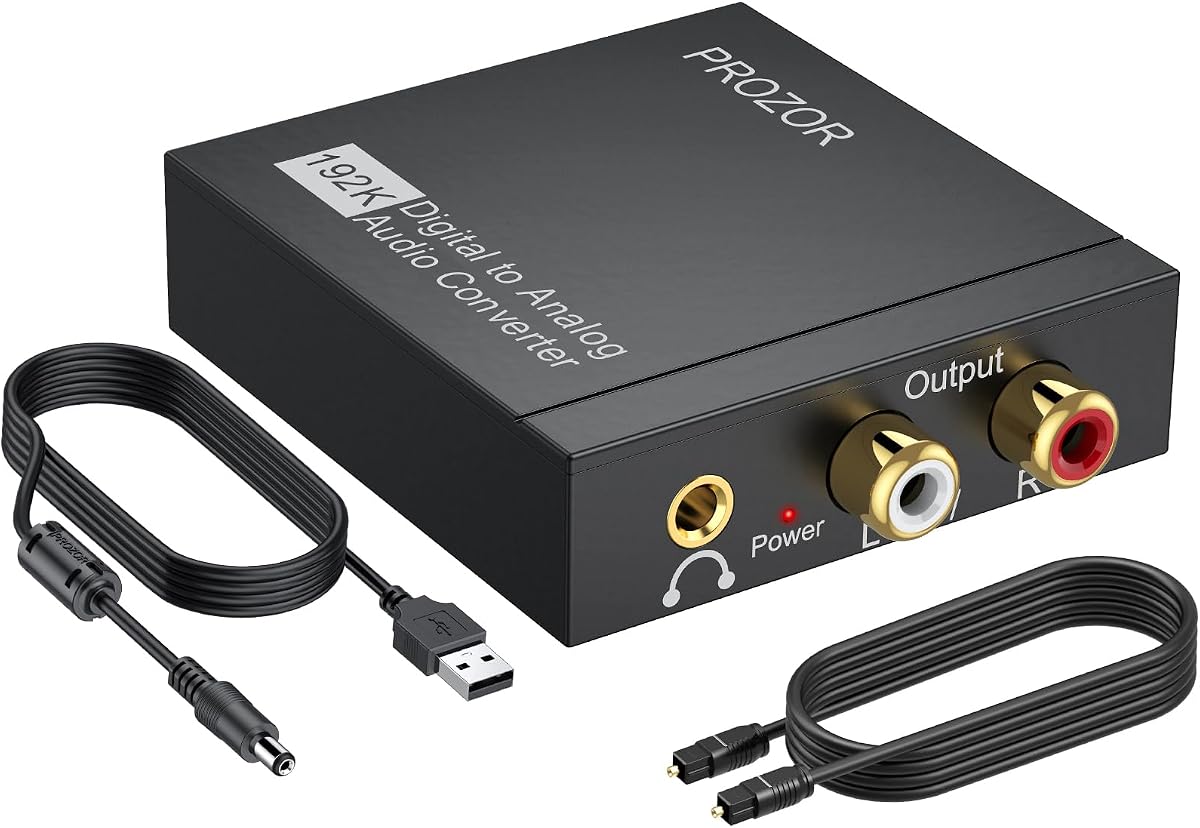


The PROZOR 192KHz Digital to Analog Audio Converter combines a versatile input selection with outputs for both analog stereo and headphones. Its 4.4 rating reflects a well-regarded general-purpose design, while the detachable aluminum housing distinguishes it from simple fixed-cable adapters. It is the strongest all-around choice for listeners who may use more than one source or need both RCA and 3.5mm connections.
We may earn a commission when you buy through this link, at no additional cost to you.
The converter accepts Toslink optical or coaxial digital PCM and sends the converted signal simultaneously to left and right RCA jacks and a 3.5mm jack. Sampling rates include 32kHz, 44.1kHz, 48kHz, 96kHz, and 192kHz, with support for a 24-bit SPDIF incoming bit stream. The package includes a three-foot optical cable and USB power cable, while a separate 5V 1A power adapter is required.
Its detachable DAC box can be replaced or repositioned without replacing the whole cable assembly, and the gold-plated RCA connectors are intended to maintain reliable signal connections. The aluminum alloy housing adds shielding and heat dissipation compared with a basic plastic enclosure. However, it supports uncompressed two-channel PCM rather than decoding surround formats such as Dolby AC-3 or DTS, so source settings must be handled carefully.
This is a sensible recommendation for a TV, disc player, or console feeding an older stereo system, especially when headphone listening is also useful. It is less appropriate for someone expecting automatic surround downmixing. Buyers should configure the source for PCM, connect the appropriate output, and use a stable certified 5V 1A supply for the cleanest result.
Optical and coaxial inputs make this converter useful with televisions, Blu-ray players, game consoles, and other sources. Simultaneous RCA and 3.5mm outputs also allow a shared audio setup to serve speakers and headphones without buying separate converters.
The detachable converter body and aluminum alloy enclosure provide a more serviceable arrangement than an all-in-one cable. Gold-plated RCA connectors and the included optical cable make it a versatile centerpiece for a permanent home-audio installation.
We may earn a commission when you buy through this link, at no additional cost to you.
The PROZOR 192KHz Digital to Analog Audio Converter is a streamlined option for someone who wants a long, uncomplicated connection between a digital source and an analog amplifier. It carries a 4.4 rating and stands out for its built-in amplifier chip, integrated RCA lead, and extended seven-foot format. The design avoids a separate converter box and works well where space is limited.
We may earn a commission when you buy through this link, at no additional cost to you.
Its optical Toslink input receives two-channel PCM or LPCM audio and converts it to left and right RCA output. The converter supports sampling rates from 32kHz through 192kHz and 24-bit SPDIF streams on both channels. An amplifier chipset is intended to address low RCA output volume, while the fixed cable simplifies the connection by eliminating the need for a separate RCA lead.
The integrated construction is convenient but less adaptable than the detachable option ranked first. A non-pluggable RCA cable cannot easily be swapped for a different length or replaced independently if damaged. The product also supports only uncompressed two-channel PCM, meaning Dolby AC-3, DTS, and other surround signals are not decoded into stereo.
Choose this adapter for a straightforward TV-to-stereo or console-to-amplifier setup where compactness and reach matter more than output flexibility. It is especially useful behind a media cabinet where a longer fixed cable reduces visible clutter. Users should set the source to PCM and power it with a certified 5V 1A adapter for stable operation.
Integrating the DAC and RCA lead reduces cable count and makes the unit easier to conceal. The seven-foot reach provides practical positioning flexibility for televisions placed against walls or on furniture.
The built-in amplifier chipset is intended to improve output strength and reduce interference-related noise. It remains important to begin with a correctly configured PCM source and a stable power supply.
We may earn a commission when you buy through this link, at no additional cost to you.
This PROZOR converter is a capable multi-output DAC for connecting digital sources to analog stereo equipment and headphones. It has a 4.4 rating and combines optical and coaxial inputs with left and right RCA outputs plus a 3.5mm jack. A built-in amplifier chip addresses low output volume, making it relevant when the connected amplifier does not provide generous gain.
We may earn a commission when you buy through this link, at no additional cost to you.
The converter supports 32kHz, 44.1kHz, 48kHz, 96kHz, and 192kHz sampling rates and a 24-bit SPDIF stream on both left and right channels. Its gold-plated RCA connectors are designed for dependable signal transfer, and the included USB lead incorporates a ferrite core intended to minimize electromagnetic and radio-frequency interference. Both RCA and 3.5mm outputs can be used simultaneously.
Its main limitation is that this is a two-channel PCM converter rather than a surround decoder. Dolby or DTS output from a television must be changed to PCM, and there is no physical volume knob to compensate for level differences among source devices or amplifiers. It is powered through USB, but the instructions call for a certified 5V 1A supply, which is not listed as included.
This model is well suited to users who want one converter to feed both an amplifier and headphones. It offers a strong balance of input choice, high-resolution support, and output flexibility. Anyone who routinely watches encoded surround content through streaming applications should first ensure the source can output PCM.
The simultaneous RCA and 3.5mm outputs provide unusual flexibility for a compact converter. It can serve a permanent stereo setup while remaining ready for private headphone listening.
The ferrite-core USB lead is intended to limit EMI and RF interference. Combined with the amplifier chip, it supports a cleaner and more stable analog output in a compact package.
We may earn a commission when you buy through this link, at no additional cost to you.
The Neoteck 192kHz DAC Converter is an approachable fixed-cable adapter with a 4.4 rating and detailed compatibility guidance. It converts optical SPDIF audio into analog RCA stereo and is designed for HD televisions, set-top boxes, disc players, and game consoles. Its seven-foot cable and compact converter housing make it convenient for connecting equipment positioned away from an amplifier.
We may earn a commission when you buy through this link, at no additional cost to you.
The high-resolution DAC supports 32kHz, 44.1kHz, 48kHz, 96kHz, and 192kHz sampling rates, along with 24-bit SPDIF input on the left and right channels. A built-in amplifier chipset is designed to raise the RCA output level and improve interference resistance. The converter handles uncompressed two-channel PCM rather than Dolby AC-3, DTS, or other surround formats.
One practical advantage is the unusually explicit troubleshooting information. The supplied description covers loose power connections, incorrect input and output modes, switching a television from automatic to PCM output, adjusting digital audio output volume, and using shielded RCA or 3.5mm cables when noise occurs. It also explains that the television remote may not directly control optical output level, depending on the television itself.
This converter suits buyers who want straightforward two-channel audio and appreciate clear instructions. It can connect modern source equipment to older speakers without decoding surround tracks. The lack of a physical volume control and the need for an external 5V 1A adapter are acceptable for a compact, inexpensive-style installation.
The supplied instructions cover common setup problems involving power, audio formats, source routing, and noise. This practical detail helps users diagnose issues without replacing the adapter unnecessarily.
The converter can be hung near the wall and its integrated RCA cable extends to an amplifier. The seven-foot arrangement reduces the need for extra interconnects while preserving a tidy installation.
We may earn a commission when you buy through this link, at no additional cost to you.
The LiNKFOR 192kHz DAC Converter earns the Best Budget badge because it combines a 4.8 rating with a straightforward all-in-one design. It converts digital optical Toslink audio into analog left and right RCA output, making it especially useful for connecting a modern television to an older amplifier or pair of powered speakers. The included cable arrangement keeps installation uncomplicated.
We may earn a commission when you buy through this link, at no additional cost to you.
The adapter supports sampling rates at 32kHz, 44.1kHz, 48kHz, 96kHz, and 192kHz, with 24-bit SPDIF input across both channels. A professional-style amplifier chip is included to increase the RCA output level and improve clarity. Its compact converter incorporates a 1.1-meter RCA cable, while the complete optical-to-RCA run is listed as six feet or 1.8 meters.
As with most entry-oriented converters in this roundup, the unit is limited to digital PCM or LPCM and does not decode Dolby AC-3, DTS, or other surround signals. It is powered by a 5V 1A USB cable. There is no manual volume control, so source and amplifier settings determine the final level, and the fixed cable cannot be replaced independently.
This is a compelling recommendation for users seeking reliable two-channel conversion without a large converter box or many extra cables. It is ideal for TVs, set-top boxes, DVD and Blu-ray players, and game consoles that can output PCM. Buyers should verify PCM compatibility before installation and use a stable USB power source.
Its integrated RCA lead allows the converter to sit near the source while reaching an analog amplifier or speaker system. The result is a clean installation with fewer separate components.
A 4.8 rating, 192kHz support, and an integrated amplifier chip provide a balanced feature set. Its format limitations are narrow and easy to address by selecting PCM at the source.
We may earn a commission when you buy through this link, at no additional cost to you.
The LiNKFOR Digital Optical SPDIF Toslink to Analog RCA DAC Converter is a compact model with a 4.3 rating. Its male optical connection and integrated RCA output provide a familiar route from modern digital equipment to an older stereo system. It is a practical option for basic television, set-top box, disc player, and game-console connections.
We may earn a commission when you buy through this link, at no additional cost to you.
The internal DAC supports 32kHz, 44.1kHz, 48kHz, 96kHz, and 192kHz sampling rates and receives a 24-bit SPDIF stream on both channels. A built-in amplifier chip is designed to produce a clearer, stronger RCA output. The body includes a 1.1-meter RCA cable, and the entire unit is powered through a 5V 1A USB connection.
The main constraint is its support for digital PCM or LPCM only. Encoded surround formats such as Dolby AC-3 and DTS are not decoded, so users may need to change the television's digital output setting. It also lacks an adjustable volume control, and its integrated cable design limits repair or replacement flexibility compared with a detachable converter.
Choose this adapter for a uncomplicated two-channel connection and a compact cable that can be tucked behind equipment. It works well with powered speakers or stereo amplifiers that accept RCA input. Prospective buyers should confirm that their source offers PCM and keep the power connection stable for reliable playback.
The converter integrates the optical input, DAC, amplifier chip, and RCA lead. That consolidation makes it easy to conceal and reduces the number of visible leads around a television cabinet.
Support for several common sampling rates up to 192kHz and 24-bit stereo input makes it suitable for current digital sources. PCM configuration remains essential for compatibility.
We may earn a commission when you buy through this link, at no additional cost to you.
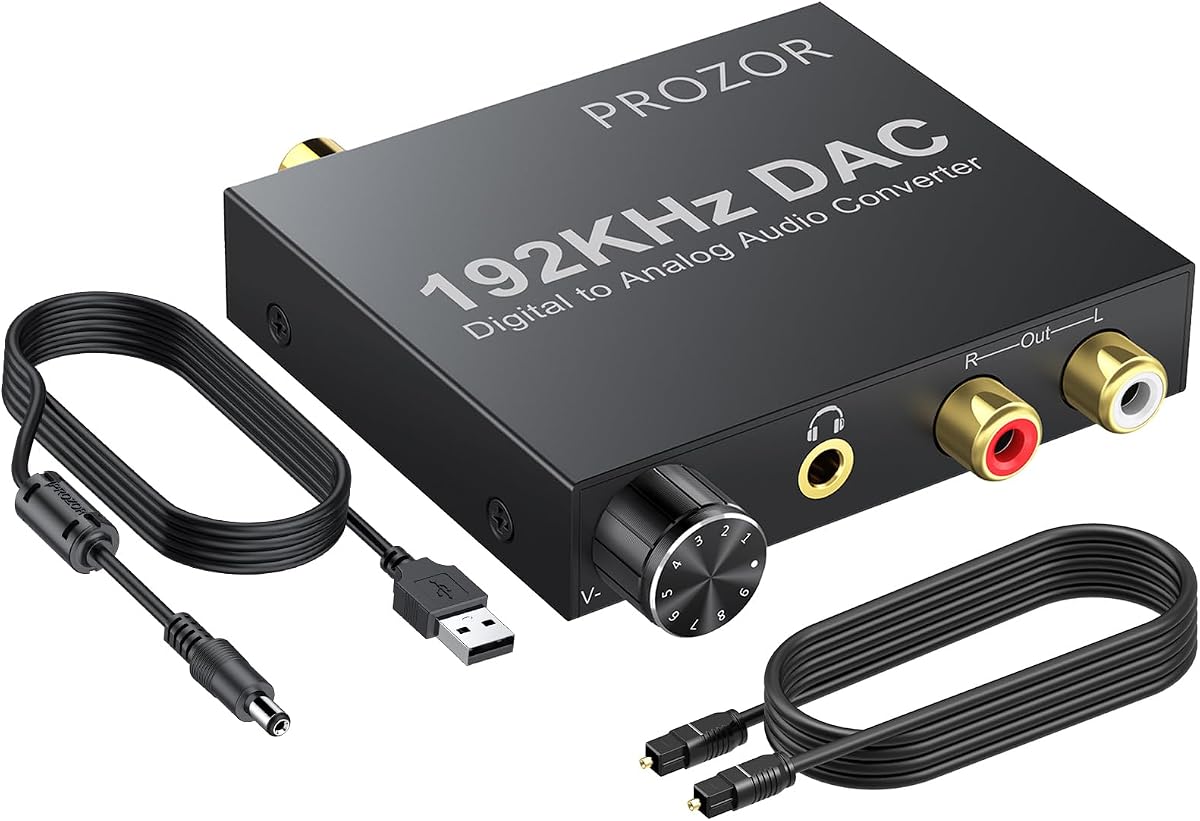
The PROZOR Volume Adjustable DAC Converter is the Best Premium selection because it adds direct control over the analog output level. With a 4.4 rating, an aluminum enclosure, gold-plated interfaces, and both RCA and 3.5mm outputs, it addresses more control needs than a basic fixed-cable converter. It is well matched to users who have noticed inconsistent volume or weak output from an older amplifier.
We may earn a commission when you buy through this link, at no additional cost to you.
Digital PCM input arrives through either a Toslink optical port or coaxial connection. The converter then provides left and right RCA and a 3.5mm jack simultaneously. It supports 32kHz, 44.1kHz, 48kHz, 96kHz, and 192kHz sampling, along with a 24-bit SPDIF stream on both channels. The built-in knob allows the output level to be matched to the connected amplifier, speakers, or headphones.
The metal shell is designed for heat resistance and a more premium feel, while gold-plated input and output interfaces are intended to reduce transmission loss. A one-meter optical cable is included. The unit still requires a 5V 1A power adapter, which is not included, and its conversion direction is one-way: digital to analog. It does not decode surround formats.
This is the recommended converter when physical level control, robust construction, and multiple output options are worth considering. It is particularly useful for combining several source types without changing amplifier settings constantly. Users should still select PCM on the source and install a stable 5V 1A supply.
The physical volume knob is the defining feature of this model. It provides quick control when different sources produce different levels or when an amplifier has limited input gain.
An aluminum enclosure and gold-plated interfaces give the converter a more permanent-installation feel. The construction is intended to aid heat handling and dependable signal connections.
We may earn a commission when you buy through this link, at no additional cost to you.
The PROZOR 192Khz 5.1-Channel DAC stands apart from most PCM-only converters in this list because it supports Dolby AC-3, DTS, LPCM, and PCM modes. Its 4.4 rating reflects a versatile design for users who need to feed surround content from a television, disc player, or console into older analog stereo equipment. The result is a downmixed two-channel signal rather than true discrete surround output.
We may earn a commission when you buy through this link, at no additional cost to you.
Both optical and coaxial digital inputs are available. Analog output is provided through left and right RCA jacks and a 3.5mm jack, allowing connection to an amplifier, powered speakers, or headphones. Sampling rates reach 192kHz, and the converter accepts a 24-bit SPDIF incoming bit stream across the left and right channels. A magnetic-ring power cord and adjustable amplifier chip are included to support stable, quiet transmission.
The key benefit is format flexibility. A television or Blu-ray player can send Dolby or DTS audio without being forced into PCM output, which is helpful for streaming services and disc content. The tradeoff is that the older stereo system receives a downmix, so discrete surround-channel separation and native surround effects cannot be reproduced.
This converter is a good fit for a home theater owner whose television has digital audio but whose amplifier or speakers are limited to analog RCA. It also suits gamers and movie viewers who want simpler operation than repeated source-menu changes. Users should still check the selected application and source output settings before purchase.
Dolby AC-3 and DTS support distinguishes this model from PCM-only alternatives. It can decode common surround signals into stereo for an analog sound system.
The magnetic-ring power cord is intended to reduce interference and improve stability. The adjustable amplifier chip complements that design by supporting a stronger RCA output.
We may earn a commission when you buy through this link, at no additional cost to you.
The eSynic 192KHZ Optical to RCA Adapter is built around a seven-foot fiber-optic run, a 24-bit DAC chip, and an aluminum housing. Its 4.2 rating makes it a worthwhile option when installation distance and shielding are priorities. The adapter is intended to bridge modern televisions or game systems and older analog audio equipment in either direction? No: conversion is strictly optical input to RCA output.
We may earn a commission when you buy through this link, at no additional cost to you.
The converter supports PCM 2.0 only and does not accept Dolby or DTS surround formats. It reaches a 192kHz sampling rate, while volume remains under the control of the connected speaker or amplifier rather than the television remote. The long, flexible optical tubing is designed to reach behind wall-mounted televisions and fit into tight spaces between media furniture and receivers.
Its aluminum body provides durable shielding and heat dissipation, while gold-plated RCA connectors are intended for stable analog connections. A status LED indicates operation. The product information contains an inconsistency about whether it draws power directly from the optical port or requires a 5V 1A USB adapter; because the latter requirement is explicitly stated in the compatibility guide, buyers should plan to supply USB power.
This converter is suitable for a basic two-channel setup with a modern source and older speakers, particularly where the source sits far from the amplifier. The long cable can reduce cable clutter, but the PCM-only restriction may be inconvenient for streaming applications that default to surround formats.
The seven-foot optical cable makes rear-of-television placement more manageable. Flexible tubing can follow tight paths without requiring several separate interconnects.
The aluminum housing helps with durability, heat management, and electromagnetic shielding. Gold-plated RCA ports complement the protected internal design.
We may earn a commission when you buy through this link, at no additional cost to you.
The eSynic 192KHZ Optical to RCA Adapter with Dolby AC-3 and DTS decoding is the most feature-focused surround converter in this roundup. It carries a 4.3 rating and focuses on converting Dolby, DTS, PCM, and other digital formats into two-channel analog audio. Its stated goal is simple operation, especially for streaming, gaming, disc playback, and legacy amplifier connections.
We may earn a commission when you buy through this link, at no additional cost to you.
The converter accepts a 5.1-channel signal from a game console, Blu-ray player, or cable box and downmixes it to stereo RCA output. A built-in amplifier chip boosts output level, while the integrated DAC supports sampling rates from 32kHz to 192kHz and 16- to 24-bit resolution. The supplied specifications also list a 105dB signal-to-noise ratio, -90dB THD+N, and a 20Hz-20kHz frequency response.
Its all-in-one construction includes a 1.1-meter RCA lead, a total stated reach of seven feet or 2.1 meters, a USB power cable, and a manual. The product description says it can draw power from a television, computer, or phone charger, although no external power brick is included. Its format handling is broader than the PCM-only adapters, making it attractive when automatic Dolby or DTS decoding is a priority.
This model is best for users who want surround-capable sources to work with analog speakers without repeatedly changing television menus. The important qualification is that downmixing produces stereo, not true multichannel output. Actual behavior can also vary with applications and source devices, so checking the selected app's output mode remains sensible.
Native decoding of common surround formats reduces menu changes and makes the converter more accommodating for streaming and disc content. The resulting analog output remains a two-channel downmix.
The listed signal-to-noise ratio, total-harmonic-distortion figure, and frequency response provide more technical detail than most competing descriptions. These figures describe the manufacturer's stated performance and should not replace compatibility checks.
We may earn a commission when you buy through this link, at no additional cost to you.
The most important considerations are source format, one-way versus surround decoding, output flexibility, power stability, and whether a manual volume control would make the setup easier.
Most basic optical-to-RCA converters accept only uncompressed two-channel PCM or LPCM. That works well after changing a television or console to PCM output, but it can interfere with streaming applications, movie discs, and games that send Dolby AC-3 or DTS. A decoder that supports surround formats can downmix those signals to stereo, offering more convenient operation even though it cannot create true multichannel RCA output.
These adapters operate from digital optical input to analog RCA output. They are not analog-to-digital converters, and most are not bidirectional. This matters if the goal is to send a signal from an older RCA amplifier into a newer digital receiver; that scenario requires the opposite conversion direction and a genuinely bidirectional or analog-to-digital device.
A stereo system needs left and right RCA outputs, while headphones may require a 3.5mm jack. Models with both can serve two listening arrangements from one converter. Detachable RCA connectors are easier to replace or substitute with different cable lengths, whereas fixed leads are more compact but less adaptable if the cable is damaged or the layout changes.
Many source devices do not let their remote controls adjust the level of an optical output. A converter with a physical knob makes it possible to match the analog signal to an amplifier or speakers and compensate for different source levels. Without such a control, users must adjust volume in television menus, the source device, or the downstream amplifier.
All ten products list support for sampling rates reaching 192kHz and compatibility with 24-bit SPDIF streams. These figures indicate high-resolution capability, but they do not mean every streaming service, television, or disc player will deliver those rates. The final resolution also depends on the source, its selected output setting, the optical cable, and the DAC's implementation.
The converters use USB power, generally from a 5V 1A supply. Several descriptions recommend a certified wall adapter rather than relying on a television's USB port. Stable power helps with noise, intermittent operation, and unexpected silence. None of the included product data should be read as guaranteeing that every listed USB source will deliver adequate current.
Cable length can determine whether a converter fits neatly behind a wall-mounted television or beside an amplifier. Fixed designs range from compact one-piece units to extended seven-foot arrangements. Optical cables can carry light over distance with less susceptibility to analog interference, while the RCA side remains vulnerable to hum if power cables run alongside it.
Aluminum enclosures provide heat dissipation and electromagnetic shielding, while plastic bodies are lighter and often less expensive. Gold-plated connectors can improve contact durability and resist corrosion. These construction details are useful, but they cannot compensate for an incompatible audio format or poorly configured source.
Begin by identifying the source's digital output and the destination's analog inputs. Connect an optical cable from the source to the converter, then route the red and white RCA leads to the matching left and right inputs on the amplifier, sound bar, or powered speakers. If using the 3.5mm output, confirm that the device accepts a stereo analog signal rather than a digital or headset-specific connection.
Power the converter with a suitable USB supply and set the source to PCM or LPCM when using a two-channel-only model. For a surround-decoding model, select Dolby or DTS when desired and allow the converter to downmix the signal to stereo. Adjust digital output volume in the source's settings if its remote does not control the optical level, or use the converter's physical knob if one is present.
For the cleanest result, connect power and audio leads with minimal overlap and replace damaged or poorly shielded interconnects. Keep the optical connector clean, avoid bending the cable sharply at the plug, and do not use the converter as a general-purpose analog-to-digital adapter. If there is no sound, first verify the selected source format, power indicator, cable seating, output routing, and downstream volume.
It converts a digital optical audio signal into analog left and right RCA audio. This lets a television, game console, Blu-ray player, or streaming box connect to an older amplifier or stereo system that accepts RCA input. The conversion is normally one-way, so the device cannot also send analog audio back into a digital system.
For most PCM-only adapters, yes: select PCM or LPCM in the television's digital audio output settings. A converter that decodes Dolby AC-3 or DTS can accept those encoded surround formats and downmix them to stereo. Even with a decoder, checking application-specific settings remains useful because streaming services can behave differently.
Only models that specifically list Dolby AC-3 and DTS decoding can do so. They downmix surround audio to two-channel analog stereo, which means the result is not true 5.1-channel output. The PROZOR 5.1-channel model and the surround-capable eSynic model are the options in this guide that explicitly support those formats.
That depends on the television. Many televisions do not adjust the volume of their digital optical output through the main remote once an external sound system is connected. In that case, change digital audio output volume in the television menu, adjust the amplifier, or choose a converter with a physical volume knob.
They require USB power, and the best practice is a stable 5V 1A source. Several product descriptions state that a wall adapter is not included, while others suggest compatible powered USB ports may work. A certified USB wall adapter is generally the more dependable option for avoiding silence, noise, or intermittent operation.
All products in this roundup list support for sampling rates up to 192kHz and 24-bit SPDIF input on the left and right channels. The actual resolution depends on the source device and selected output mode. A high-resolution specification also cannot create surround separation in a converter that only outputs two stereo channels.
A fixed cable is compact, simple, and usually less cluttered, but it cannot be replaced independently if damaged. A detachable converter accepts different RCA leads, works better with unusual cable lengths, and can be repositioned without replacing the entire assembly. Fixed designs are convenient for standard setups, while detachable ones suit permanent installations.
Check that the source is set to PCM for a two-channel converter, the optical cable is firmly seated, and the correct TV speaker or external-audio output is enabled. Also verify the USB power connection, the 5V 1A requirement, and the downstream amplifier input. If audio is distorted or intermittent, check the selected digital format and use shielded RCA cables.
The LiNKFOR 192kHz DAC Converter is the best budget-oriented choice for a straightforward PCM connection, while the detachable PROZOR DAC Converter offers the strongest all-around balance of input choices, serviceability, and analog outputs. The PROZOR adjustable model earns the premium designation for users who value direct output-level control and metal construction.
Before choosing, prioritize compatibility rather than headline specifications. Confirm that the source can deliver the required format, decide whether surround decoding is necessary, and verify that the converter has the right outputs and physical arrangement for the room. Stable USB power and proper PCM configuration are just as important as the advertised sampling rate.
Product details, ratings, and prices can change, and availability may vary over time. Review the current listing and manufacturer instructions before purchase, especially if the setup depends on streaming applications, gaming consoles, or a particular television's audio-menu behavior.