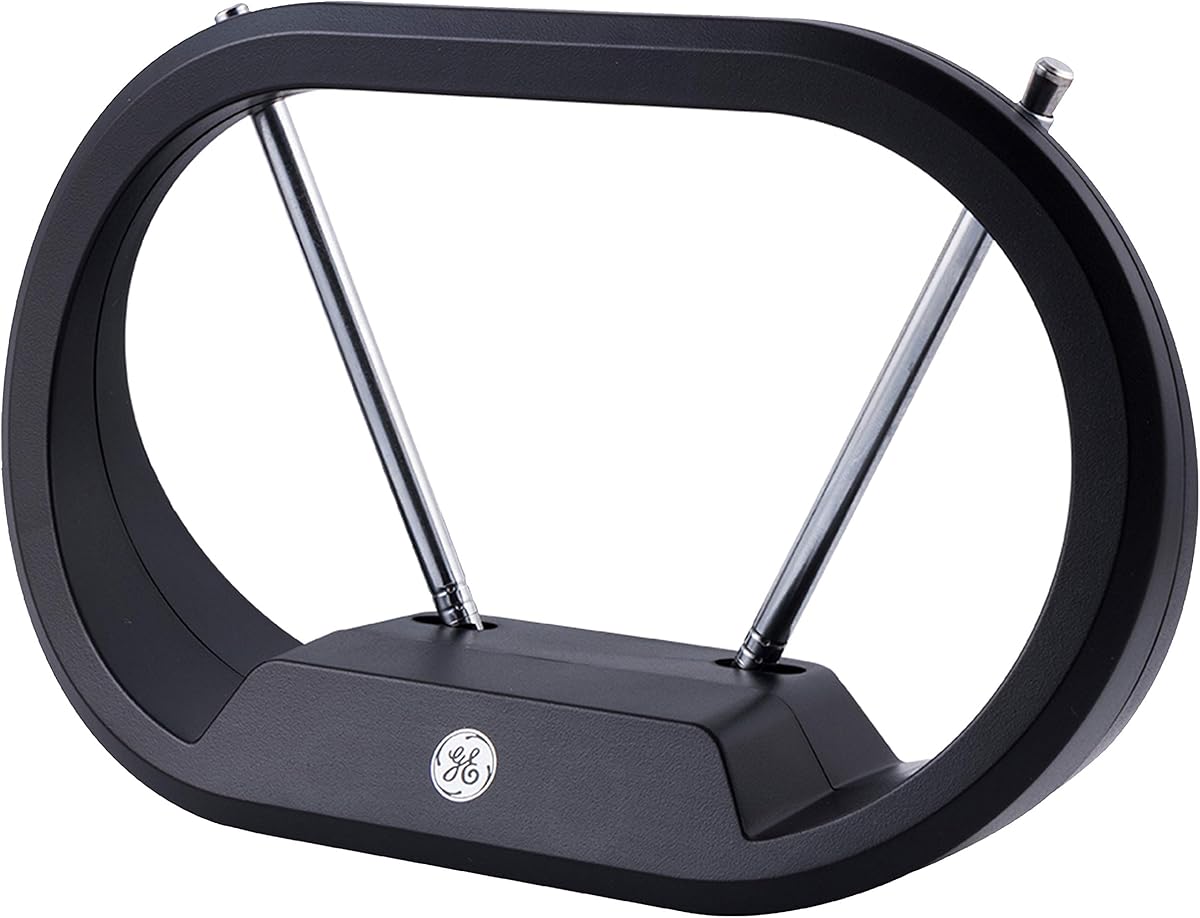
GE Modern Loop Rabbit Ears
4.1Editor score
Thirty-mile stated reception range
Adjustable loop and dipoles
4K and 8K TV ready
Four-foot coaxial cable included
Compare the best Rabbit Ears TV Antenna options for indoor reception, adjustable signal tuning, easy setup, channel coverage, and everyday use.
Rabbit ears antennas remain a straightforward way to receive local television broadcasts without a monthly cable or satellite subscription. A useful model should balance VHF and UHF reception, offer adjustable elements, connect easily to modern televisions, and fit comfortably into an indoor entertainment setup.
This guide compares ten rabbit ears and closely related indoor antennas based on signal coverage, adjustable reception, supported broadcast formats, included cables, installation requirements, design, and practical support. The list includes established branded models, compact alternatives, and a multipack for households that need antennas in several rooms.
Each review identifies the product's strongest benefits and realistic limitations so the right choice depends on more than appearance alone. Signal conditions remain local, so placement, broadcast-tower direction, terrain, buildings, and weather can affect results. Product details, ratings, and availability may change over time.
4.1Editor score

4.2Editor score

4.0Editor score
The comparison below highlights antenna type, reception design, stated coverage, resolution support, setup considerations, and the most important trade-offs across all ten products.


The Philips Rabbit Ears Black Indoor TV Antenna combines extendable dipoles with a circular UHF loop in a familiar tabletop design. Its 4.2 rating reflects a generally positive reception of its balance of features, physical design, and setup convenience. The antenna is aimed at viewers who want an uncomplicated way to receive available local channels on a modern television.
We may earn a commission when you buy through this link, at no additional cost to you.
Its most useful feature is the combination of two reception elements. The dipoles can be extended and repositioned for VHF signals, while the circular loop provides dedicated UHF reception. Together, they give users several ways to improve the signal without moving the entire antenna immediately. Compatibility with 1080p broadcasts, 4K and 8K-ready televisions, and ATSC 3.0 where available makes the product suitable for both current and newer television ecosystems.
Setup is straightforward: place the antenna on a shelf or table, connect the included coaxial cable, and scan for channels. U.S.-based technical support and a limited-lifetime replacement pledge add confidence for buyers who want a recognized consumer brand behind the product. The main limitation is that no numeric reception range is supplied, so expectations should be based on local broadcast availability rather than a guaranteed distance.
This is a strong general recommendation for users in suburban or urban locations who want recognizable rabbit ears styling, modern broadcast compatibility, and easy physical adjustment. It works especially well as a primary indoor antenna or cable backup when the television is reasonably close to broadcast towers and the user is willing to experiment with placement.
The antenna is less suited to users who need a stated long-range figure, outdoor mounting, or guaranteed reception in challenging terrain. Even so, its flexible construction and modern television support make it one of the most complete conventional choices in this roundup.
Extending or repositioning the dipoles can help with VHF stations, while rotating or adjusting the loop changes the UHF direction. These controls make it possible to respond to different local tower layouts without purchasing another antenna.
Support for 1080p, 4K and 8K-ready displays, plus ATSC 3.0 where offered, allows the antenna to work with current smart televisions and newer broadcast equipment. Actual channel resolution remains determined by the station's broadcast.
We may earn a commission when you buy through this link, at no additional cost to you.
The Philips Indoor TV Antenna Rabbit Ears for Local Channels offers a more clearly specified coverage target than many compact models. Its 4.1 rating and stated ability to receive VHF and UHF broadcasts from up to 30 miles make it a practical candidate for households seeking traditional indoor antenna performance without moving into an outdoor installation.
We may earn a commission when you buy through this link, at no additional cost to you.
The modern loop and adjustable dipoles allow both directional tuning and broad placement flexibility. The included four-foot coaxial cable is suitable for a television or nearby digital converter box, while the antenna's support for 4K and 8K Ultra HD-ready televisions makes it relevant to modern displays. It is also listed as compatible with ATSC 3.0 broadcasts where available.
Its main advantage over a minimalist rabbit ears design is the combination of a stated range and multiple adjustment points. That makes it easier for buyers to judge whether it suits their local broadcast conditions. The trade-off is that indoor placement remains the deciding factor: buildings, terrain, electrical interference, and the direction of transmitters can materially change the outcome, and a stated maximum is not a promise for every household.
This Philips model is best for viewers who want a recognizable brand, a traditional but modernized loop-and-dipole design, and a clear setup process. It is appropriate for a bedroom, living room, apartment, or backup setup where the television can be placed relatively close to broadcast transmitters.
Users in distant locations, obstructed homes, or areas with rapidly changing reception may still need to experiment with orientation or consider an outdoor solution. For most ordinary indoor installations, however, this antenna provides useful controls and clear compatibility information in a familiar format.
The stated 30-mile range gives shoppers a useful reference when comparing indoor models. It should still be treated as a laboratory-style maximum rather than a guarantee because local geography and building materials can reduce usable indoor range.
The four-foot coaxial cable supports a straightforward connection to nearby equipment. Adjusting the dipoles and loop provides a practical way to optimize reception after the television completes its channel scan.
We may earn a commission when you buy through this link, at no additional cost to you.
The GE Modern Loop Rabbit Ears Indoor TV Antenna uses 15-inch extendable dipoles and an adjustable loop to receive local VHF and UHF broadcasts. Its 4.1 rating suggests a solid overall reception of its familiar construction, useful coverage claim, and modern compatibility features. It is a sensible choice for buyers who prioritize straightforward adjustment over an ultra-thin or fully hidden installation.
We may earn a commission when you buy through this link, at no additional cost to you.
The antenna is listed for reception from up to 30 miles, although real results depend on tower distance and the surrounding environment. It supports 1080p broadcasts and is ready for 4K and 8K Ultra HD televisions, as well as ATSC 3.0 signals where those are available. The included four-foot coaxial cable and tabletop installation process keep the setup uncomplicated.
GE quality and support add value for buyers who want a recognizable brand and access to U.S.-based technical assistance. A limited-lifetime replacement pledge is another reassurance. The design does take up more visual space than a flat panel or tiny indoor antenna, and the flexible elements need room to extend, so it is better suited to a visible shelf than a tightly minimalist media area.
This model works well for apartments, bedrooms, and living rooms where local towers are within a moderate distance and the user wants the ability to tune the antenna manually. It is also a sensible option for households seeking a backup antenna for cable service or severe-weather outages.
Those living beyond the stated range or inside heavily obstructed buildings may need a higher-gain or outdoor solution. For a typical indoor rabbit ears installation, however, this GE combines useful range, clear adjustment controls, and broad television compatibility in a well-established format.
Long extendable dipoles give users more freedom to change the angle between VHF stations and transmitters. Their extra length also makes the antenna easier to fine-tune when a television stands against a wall or inside an entertainment cabinet.
The antenna is designed for 4K and 8K Ultra HD-ready televisions and includes ATSC 3.0 compatibility where available. These features support modern equipment, while the actual broadcast format still depends on the local station.
We may earn a commission when you buy through this link, at no additional cost to you.
The HIDB Compact Rabbit Ears is designed for people who need a television antenna without dedicating visible shelf space to a large set of elements. Its 3.8 rating reflects a mixed but practical feature set: a small footprint, flexible placement, broad television compatibility, and a simple installation process for common over-the-air broadcasting.
We may earn a commission when you buy through this link, at no additional cost to you.
This model supports 1080p and 4K channels where available and can connect to a smart television or digital converter box. A suction cup and double-sided tape provide alternative mounting methods, while the compact dimensions make it easier to position near a window or higher on a wall. The product information describes 180-degree directional reception and an ambitious range claim of up to 120 miles.
That maximum range should be interpreted cautiously because indoor antenna performance depends on distance, terrain, obstructions, interference, and tower direction. Small antennas can receive strong nearby signals very well, but an extended reach claim does not guarantee dozens of stations in every location. The mounting accessories are also useful because they make it easier to test different positions without repeatedly moving the television.
The product suits renters, apartment residents, dorm occupants, and anyone with limited entertainment-console space. It is also a useful travel-oriented option for compatible indoor setups, although it should not be treated as a universal outdoor solution. Users should always rescan channels after changing the antenna's location.
For shoppers who prioritize compactness over the physical size and long adjustable elements of conventional rabbit ears, this HIDB provides a practical alternative. Clear expectations about local coverage make it easier to decide whether its compact format is worth the tradeoff.
A suction cup and double-sided tape allow the antenna to be placed in more locations than a conventional tabletop model. Higher or window-side placement can sometimes improve access to broadcast signals.
The small body is useful around televisions with limited shelf space. Compared with full-size rabbit ears, however, buyers have fewer physical elements with which to fine-tune directional reception.
We may earn a commission when you buy through this link, at no additional cost to you.
The Compact Adjustable Rabbit Ears stands out in the ratings data with a 5.0 rating while offering a small, approachable indoor antenna design. It supports smart televisions, HDTVs, older sets with built-in tuners, and digital converter boxes, making it one of the most broadly compatible products in the roundup.
We may earn a commission when you buy through this link, at no additional cost to you.
Its adjustable dipoles are designed to receive available VHF and UHF signals, and the unit is ready for 4K and 1080p television content. Installation is described as a three-step process: connect the antenna to the television's Antenna In or RF In port, select the appropriate input, and scan for available channels.
The product's compact dimensions make it well suited to television stands, shelves, desks, windowsills, bedrooms, apartments, dorm rooms, kitchens, and recreational vehicles. Its lightweight body also makes repeated placement tests convenient. As with other indoor antennas, however, actual performance will vary based on proximity to transmitters, building layout, and the direction in which the dipoles are positioned.
This is a strong option for buyers who need broad device compatibility but have limited space. It can serve a bedroom television, an apartment set, or a secondary display where a large antenna would be inconvenient. Older televisions work when they include a compatible tuner, while sets without a tuner still require an external converter box.
The main limitation is the absence of a stated maximum range or advanced directional controls. Buyers in strong-signal areas will likely appreciate its simplicity, while those farther from broadcast towers may need a larger antenna or a more elevated installation.
Compatibility with antenna-equipped smart TVs, HDTVs, older built-in-tuner televisions, and converter boxes makes this antenna adaptable to a range of homes. The appropriate port and input setting remain important during setup.
The stated dimensions allow the antenna to fit comfortably in entertainment areas where full-size elements would be intrusive. It is particularly appealing for secondary rooms and temporary indoor television setups.
We may earn a commission when you buy through this link, at no additional cost to you.
The Wideskall Universal Indoor Rabbit Ear TV Antenna offers a traditional dual-loop design with a 3.7 rating among the lower-rated products in this list. Its appeal lies in a familiar form factor, universal VHF and UHF positioning, and support for HDTV and FM radio broadcasts rather than a broad collection of modern compatibility claims.
We may earn a commission when you buy through this link, at no additional cost to you.
The antenna extends to a maximum stated length of 24 inches and includes a three-foot coaxial cable. Its dual-loop structure offers more than one element to position, which can help when local transmitters are spread across different directions. It supports broadcasts up to 1080i, providing quality that remains suitable for many conventional television viewing needs.
Compared with newer models, the specification list is intentionally brief. There is no listed 4K or 8K compatibility, no ATSC 3.0 reference, and no numerical reception-range claim. That does not prevent the antenna from being used with a 4K television, since the television and station determine final resolution, but it gives buyers fewer forward-looking details to assess.
This Wideskall model is most appropriate for users seeking a straightforward indoor antenna near strong or moderate local signals. It may also appeal to anyone interested in receiving FM radio broadcasts alongside television. Placement near a window and adjustment of the loop elements can improve results when multiple directions need to be tested.
Its lower rating and limited technical information make it harder to recommend for challenging reception areas. Nevertheless, for a simple indoor installation, the universal dual-loop design and included connection cable provide the core functionality buyers need.
Two loop elements can be oriented differently to test more than one incoming direction. This makes the antenna a practical traditional option when the user is unsure which way local broadcast towers lie.
The antenna supports HDTV broadcasts up to 1080i and FM radio reception. Its three-foot cable is convenient for televisions positioned close to the antenna.
We may earn a commission when you buy through this link, at no additional cost to you.
The HIDB Omnidirectional Indoor TV Antenna takes a different approach from conventional extendable rabbit ears. Its 3.8 rating accompanies a compact, slim body intended to blend into a living room, bedroom, apartment, or other indoor entertainment area. The defining feature is omnidirectional reception, which removes the need to orient a single narrow field toward a tower.
We may earn a commission when you buy through this link, at no additional cost to you.
The antenna is made from dual PC soft material rather than ordinary PVC. The product information describes this construction as flame retardant, moisture resistant, and protective against lightning for indoor use. It is designed to connect with smart televisions and digital converter boxes, providing access to available local stations without a cable subscription.
Its compact, lightweight construction makes it easy to move between rooms or experiment with a higher position. The manufacturer recommends scanning for channels, testing both vertical and horizontal placement, and positioning the unit high and near a window facing local broadcast towers. Actual reception still depends on location, terrain, and weather.
This model is a good fit for users who dislike conspicuous rabbit ears or do not know where transmitters are located. The omnidirectional approach can simplify initial setup, although it may not offer the same directional refinement as extendable dipoles. It is best used where local signal strength is reliable enough for a less mechanically adjustable antenna.
A support service is available for setup and reception questions. While the antenna lacks a stated maximum range, its discreet construction and broad placement flexibility make it a practical option for secondary televisions and modern homes where appearance matters.
An omnidirectional design can simplify setup when broadcast towers surround the home or their exact direction is unclear. It reduces the need to rotate and fine-tune extendable elements.
The slim body and lightweight materials allow the antenna to sit discreetly near a television or window. Soft PC construction also distinguishes it from the harder plastic used in many traditional designs.
We may earn a commission when you buy through this link, at no additional cost to you.
The GE Flat Panel Indoor HD Digital TV Antenna combines a cleaner appearance with a stated reception range of up to 40 miles. Its 4.1 rating makes it one of the stronger alternatives in the roundup for viewers who want more coverage than a typical compact rabbit ears model without installing an outdoor antenna.
We may earn a commission when you buy through this link, at no additional cost to you.
The panel is optimized for VHF and UHF broadcasts, allowing it to receive both major frequency bands used by local television stations. It supports 1080p HD, 4K Ultra HD, and NextGen TV ATSC 3.0 broadcasts where available. The stated ATSC 3.0 capability can provide a stronger signal, premium audio, richer color, and faster refresh rates when the broadcaster offers those features.
An adjustable stand allows horizontal or vertical placement, giving users a degree of orientation control without extending separate elements. The included coaxial cable and direct connection to televisions or converter boxes simplify installation. Compared with traditional rabbit ears, the panel occupies a smaller visual footprint while still needing enough room to operate.
This antenna is a strong option for apartments, urban homes, and suburban living rooms where local transmitters are at a moderate distance. It also works well for users who want an antenna that looks less like traditional rabbit ears or plan to place it near a television in a more visible location.
Its 40-mile claim remains conditional on an unobstructed local signal, and the panel cannot overcome every terrain or building problem. Even so, it combines modern format support, VHF and UHF reception, and understated styling in a practical indoor package.
The stated 40-mile reach provides a useful comparison point with 30-mile rabbit ears models. Support for ATSC 3.0 and modern high-resolution displays adds compatibility for current and next-generation television systems.
The stand can be placed horizontally or vertically to fit the entertainment area and align with available signals. This flexibility is useful near windows, entertainment centers, and televisions positioned against walls.
We may earn a commission when you buy through this link, at no additional cost to you.
The Philips Rabbit Ears Three-Pack is built for households that want local television reception in more than one location. Its 4.1 rating and inclusion of three individual antennas make it especially useful for bedrooms, guest rooms, offices, and separate living areas where moving one unit between televisions would be inconvenient.
We may earn a commission when you buy through this link, at no additional cost to you.
Each antenna uses a modern loop with 15-inch extendable dipoles and is listed for VHF and UHF reception from up to 30 miles. Support for 1080p, 4K Ultra HD, and 8K Ultra HD-ready televisions makes the pack useful with modern displays, while ATSC 3.0 compatibility where available adds forward-looking broadcast support.
Setup is familiar: place each unit on a flat surface, connect the included four-foot coaxial cable, and run a channel scan. Because signal conditions differ from room to room, each antenna may require separate positioning. Walls, interior fixtures, and the direction of the television can influence results even when the units are otherwise identical.
The pack is a good choice for families adding television service to secondary rooms or for landlords furnishing multiple units. It is also convenient as a backup because an antenna can be kept in another room without requiring the primary installation to be dismantled.
For a single-room setup, three antennas may be unnecessary, and each unit still has the same indoor reception limitations as the individual Philips model. The value of this option comes from installation flexibility across several television locations.
The three-pack allows simultaneous placement in separate rooms, avoiding the need to unplug and carry one unit between locations. Each television can then be scanned using its own antenna.
Every unit provides the same adjustable loop, extendable dipoles, and modern broadcast compatibility. Buyers covering several similar spaces can use a consistent setup throughout the home.
We may earn a commission when you buy through this link, at no additional cost to you.
The Winegard FlatWave FL5500A is an amplified, multidirectional indoor antenna designed primarily for urban and suburban environments. Its 4.0 rating reflects a feature set oriented toward stronger stated range, modern broadcast support, and refined installation. Although it is not a conventional pair of extendable rabbit ears, it is a premium alternative for buyers seeking more flexibility and a less exposed design.
We may earn a commission when you buy through this link, at no additional cost to you.
Winegard states that the FL5500A can receive VHF and UHF over-the-air signals from as far as 60 miles away. Its amplified multidirectional configuration is intended to deliver consistent local channel access, although terrain, buildings, interference, and station transmission strength still determine actual results. The panel supports NextGen TV-enabled broadcasts and works with most smart televisions and streaming devices that accept a coax connection.
The ultra-thin FlatWave construction uses a low-profile dual-color aesthetic that can blend into most interiors without complex mounting hardware. Installation requires no tools: connect the antenna to a television's coax input, run a channel scan, and use the Winegard app as setup guidance. Those features make it especially appealing to users who want a polished, modern antenna rather than visible metal elements.
This model is well suited to households seeking more reach than conventional indoor rabbit ears, particularly in urban and suburban locations where transmitters are farther away. It can also serve as an elegant second television antenna in a bedroom or media area.
Amplification does not guarantee reception through severe obstructions or compensate for a distant transmitter beyond practical range. Despite that limitation, the FL5500A combines strong stated coverage, guided setup, multidirectional reception, and discreet construction into a premium indoor package.
The combination of amplification and multidirectional reception is designed for consistent access to VHF and UHF stations. It can reduce the need for precise manual aiming, although signal quality still depends on the local environment.
The thin dual-color panel suits visible entertainment spaces better than a large traditional antenna. Winegard's app offers setup guidance, while direct coax connection keeps the physical installation simple.
We may earn a commission when you buy through this link, at no additional cost to you.
The right indoor antenna depends on local signal conditions, television compatibility, available space, and how much physical adjustment you want to manage. These factors help separate a convenient tabletop choice from a model better suited to multi-room use or more demanding reception.
Start by checking which stations serve your address and where their broadcast towers are located. A nearby tower generally gives indoor antennas a better chance of receiving several stable channels, while a distant or obstructed tower benefits from greater amplification, directional control, or a higher placement. Stated ranges such as 30, 40, and 60 miles provide a comparison point, but they are maximum claims rather than guarantees. Terrain, buildings, trees, interior walls, and nearby electronic equipment can all influence the result.
Local television stations operate in VHF and UHF bands, so an antenna should support both. Rabbit ears models commonly use extendable dipoles for VHF and a loop for UHF, while omnidirectional and multidirectional panels distribute reception around a wider area. A model with separate elements gives users more ways to tune difficult stations, whereas an omnidirectional design simplifies initial placement. Neither approach overcomes every obstruction, but matching the antenna's directional behavior to the local tower layout can improve consistency.
Most modern smart televisions have a tuner and coax input for over-the-air broadcasts, but older sets may also work if they include a compatible tuner. Sets without a tuner require a digital converter box between the antenna and television. Look for a clearly documented antenna or RF input connection and verify whether a coaxial cable is included. Resolution claims such as 1080p, 4K, and 8K readiness describe compatibility with the television rather than the quality every station will deliver.
ATSC 3.0, also called NextGen TV, support can be useful for compatible televisions and future broadcast enhancements where such services are available. It does not mean every station will transmit in that format, and it cannot create stronger signals. A model that works with current ATSC broadcasts remains functional regardless. Modern compatibility matters most when replacing equipment or preparing a household for newer local broadcast services.
Extendable dipoles and rotating loops are useful because tower direction and interior obstacles are not always obvious. A compact antenna may be easier to conceal but offer fewer tuning options. Adjustable stands help flat panels sit upright or horizontally. Placement options such as suction cups and tape can make high or window-side testing easier. Choose an antenna with enough control to fit your room, but avoid excessive size if the antenna will be visible in a main entertainment area.
Tabletop models are convenient when the television and antenna can sit together, while flat panels offer a less traditional appearance and can be positioned beside a screen. Check the included cable length because the antenna should not be stretched or bent to reach a distant port. Most installations require only a coax connection and a channel scan, but every television menu and model is different. Follow the manufacturer's setup sequence and rescan whenever the antenna is moved.
Amplification can help preserve usable signal through longer cables or improve reception from moderately distant stations, but it cannot pull in a station that never reaches the antenna. Traditional rabbit ears rely primarily on element length and positioning, while amplified panels may be more forgiving in suburban areas. Compare stated ranges while remembering that actual indoor performance depends on the location. Strong local signals usually require less help than weak ones.
U.S.-based technical support, replacement commitments, and included instructions can be valuable when reception problems arise. Households with several televisions should consider a multipack, while occasional viewers may prefer a single compact unit. Consider where the antenna will be stored, whether children or pets could reach extendable elements, and whether a low-profile design is preferable. The best choice is the one you can position safely and tune with confidence.
Begin by placing the antenna near the television on a stable, level surface. Connect the supplied coaxial cable to the television's antenna or RF input, select the corresponding input on the television, and complete its automatic or manual channel scan. Avoid placing the antenna directly beside known sources of electrical interference, and keep the extendable elements fully free to move rather than tightly folded.
If important stations are missing, extend the dipoles, rotate the loop or panel, and move the antenna a few feet at a time. Try a higher location and a position near a window that faces the broadcast towers. Run a new channel scan after every meaningful change because the television must reassess which signals are available. Testing both vertical and horizontal orientations can also help distinguish a placement problem from a channel-availability issue.
For routine care, handle the antenna by its base or stand rather than pulling on the telescoping dipoles. Keep the connectors dry and avoid sharply bending the coaxial cable. Periodically inspect the connections if reception becomes unstable, and clean the exterior gently with a dry or lightly damp cloth. Store the antenna in a dry location with its elements reasonably extended when possible.
A rabbit ears antenna only receives over-the-air broadcasts available in your area. Cable may carry additional networks, streaming channels, or local stations delivered by cable infrastructure that cannot be received by an antenna. Check local broadcast maps to identify the stations and services you can expect to receive.
Extend the dipoles fully, then rotate them independently and adjust the UHF loop in small increments. Rescan channels after each change. If reception remains weak, move the antenna higher, rotate the entire unit, or try a window facing the local broadcast towers.
They can work in both, but the results depend on the distance to transmitters and the building materials between the antenna and the stations. Concrete, metal, brick, and dense walls can weaken reception. Apartment residents may achieve better results by placing the antenna near a window or higher in the room.
An amplifier is most useful when signals are weak, the antenna is far from the transmitter, or a longer cable is required. Strong nearby stations often work well with a basic indoor antenna. Amplification cannot recover a signal that is completely blocked before it reaches the antenna.
Yes, if the television includes an analog or digital broadcast tuner and the correct antenna input. If the set only has analog inputs or no tuner, connect the antenna to a digital converter box and then connect the box to the television.
Moving or rotating an antenna changes which channels are strong enough to receive. The television's previous scan reflects the old signal conditions. A new scan updates its channel list and can restore stations or remove channels that are no longer available at that position.
A window can help when it faces the direction of broadcast towers and reduces some exterior wall obstruction. It may also introduce interference or poor grounding, so results can vary. Test the antenna in more than one location and keep the final position where the most desired channels remain stable.
Neither is universally better. Flat panels often offer a cleaner appearance, multidirectional reception, and amplification, while rabbit ears provide visible directional tuning through extendable elements. Consider local tower direction, available space, and how much manual adjustment you prefer.
The Philips Rabbit Ears Black is the strongest all-around conventional choice, combining adjustable VHF and UHF elements with modern television compatibility and simple installation. The GE Modern Loop offers dependable tuning controls and a stated thirty-mile range, while the Winegard FlatWave FL5500A stands out as the premium amplified alternative for shoppers who want broader coverage and a discreet panel.
Prioritize reception conditions over appearance alone. Check which stations are available locally, note the direction of the towers, and consider the antenna's stated range, tuning controls, connection method, and placement flexibility. Compact models suit secondary rooms, multipacks serve multiple televisions, and larger adjustable designs provide more options when signals are inconsistent.
Finally, review current product listings, ratings, included accessories, and support details before purchasing. Indoor reception is personal to the building and location, so keeping the antenna, rescanning channels, and testing several positions are essential parts of getting the most from any model.